
Leaf 1 and Leaf 2 share the highest published uncapped RTP, 97.10%. Backing both does not raise that rate.
Same-budget comparison · One or both Leaves · All Bonuses · All five fields · Mixed bets · Bankroll and doubling
Compare Bet Types at the Same €6 Budget
The money examples follow the SNAI settlement convention: an ordinary winning Leaf credits twice its stake; a fish credits winning stake × final fish multiplier, with no extra initial fish stake added. The amounts are worked examples, assuming every placement is accepted and no payout is capped.

The matching-field probabilities below use equal-probability segments on the 53-segment wheel. They describe wheel coverage, not observed frequencies or a blanket chance of net profit. RTP values describe theoretical average return before cap effects.
| Bet layout | Allocation of the €6 budget | Matching field in the uniform model | Uncapped combined RTP | Ordinary Leaf 1: credited return / net |
|---|---|---|---|---|
| One Leaf | €6 on Leaf 1 | 23/53 — 43.40% | 97.10% | €12 / +€6 |
| Both Leaves | €3 on Leaf 1 and €3 on Leaf 2 | 46/53 — 86.79% | 97.10% | €6 / €0 |
| All Bonuses | €2 each on Blue, Orange and Red | 7/53 — 13.21% | 95.4867% | €0 / −€6 |
| All five fields | €1.20 on each field | 53/53 — 100% | 96.132% | €2.40 / −€3.60 |
| Leaf 1 + Red | €3 on Leaf 1 and €3 on Red | 24/53 — 45.28% | 96.135% | €6 / €0 |
All five fields and the equal Leaf–Red split have almost the same RTP. Their ordinary Leaf results still settle differently because the winning Leaf stake receives different shares of the budget. Compare those round credits as well as the average return.
For any accepted layout:
Net round result = total credited return − TOTAL BET
Only the matching field pays. Stakes on the other fields remain part of TOTAL BET. A layout can therefore contain a winning bet and still leave a net loss.
Explanation diagram Scroll to explore
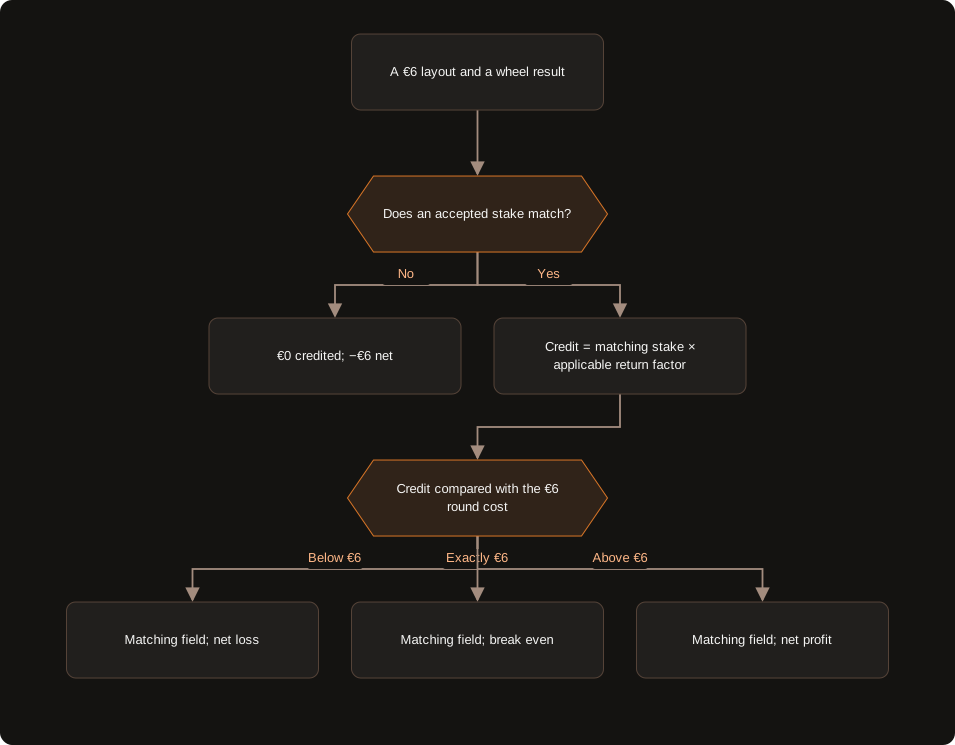
This compares the worked uncapped examples. Covering the wheel result determines which stake can pay; the credited amount determines whether the whole round gains, breaks even or loses.
One Leaf or Both Leaves?
Putting the full €6 on Leaf 1 gives an ordinary matching return of €12 and +€6 net. Leaf 2 and all three fish results leave the €6 stake lost. Leaf 1 and Leaf 2 each occupy 23 segments and each have 97.10% published uncapped RTP, so switching the label alone does not improve the mathematical rate.
Splitting the same budget into €3 on each Leaf doubles the number of covered segments to 46. An ordinary result on either Leaf credits €6, exactly covering the two stakes. All fish results still lose the entire €6 Leaf layout.
| Wheel result | €6 on Leaf 1: credited / net | €3 on each Leaf: credited / net |
|---|---|---|
| Ordinary Leaf 1 | €12 / +€6 | €6 / €0 |
| Ordinary Leaf 2 | €0 / −€6 | €6 / €0 |
| Leaf 1 segment carrying a 10× return | €60 / +€54 | €30 / +€24 |
| Any fish result | €0 / −€6 | €0 / −€6 |
A boosted Leaf can produce a positive net result with both Leaves backed. The boost applies to its selected segment, not every segment of that Leaf field; the Leaf boost rules explain the scope. A displayed 10× Leaf return credits ten times the matching stake.
Equal stakes are what make the ordinary Leaf return break even. With €4 on Leaf 1 and €2 on Leaf 2, the same €6 budget gives +€2 on an ordinary Leaf 1 result but −€2 on ordinary Leaf 2. The combined RTP remains 97.10% because both inputs have the same rate, although the round outcomes differ.
The 86.79% covered share for two Leaves includes ordinary break-even outcomes. It cannot be read as an 86.79% chance of increasing the balance. Calculating the probability of a positive net result would also require the boost distribution.
All Bonuses: Three Stakes Within One Budget
All Bonuses places the selected amount on each of the three fish fields. At a €6 total budget, that means €2 on Lil’ Blues, €2 on Big Oranges and €2 on Huge Reds. Selecting €6 for each fish instead would cost €18.
The layout covers all seven fish segments in the uniform model. When a fish wins, only its €2 stake receives the multiplier. The €4 on the other fish fields is still included in the round cost.
| Wheel result, with no fish boost | Credited return from the fish bets | Net after the €6 round cost |
|---|---|---|
| Either Leaf | €0 | −€6 |
| Lil’ Blues at its 3× minimum | €6 | €0 |
| Big Oranges at its 4× minimum | €8 | +€2 |
| Huge Reds at its 10× minimum | €20 | +€14 |
The minimum Blue catch only covers the cost of this fish layout under the SNAI convention. Orange and Red have higher minimum factors but smaller wheel shares: 2/53 and 1/53, compared with Blue’s 4/53. The fish bonus comparison gives their ranges and boost mechanics.
The equal-stake RTP of All Bonuses is 95.4867% before cash-cap effects. Covering all three fish moves two-thirds of the money away from Blue’s higher 95.69% uncapped rate, adding Orange and Red coverage at their lower rates.
At a qualifying 5,000× Red result, this layout’s €2 Red stake would credit €10,000 before any applicable cap. Relative to the €6 total cost, that is about 1,666.67×. The maximum payout calculations show why the factor on the winning stake differs from the return on the whole budget. This worked result gives no estimate of how often 5,000× occurs.
Covering All Five Fields
Equal stakes on all five fields divide the €6 budget into €1.20 per field. Every wheel result has a matching stake, but each matching stake is only one-fifth of the cost.
| Worked wheel result | Credited return from €1.20 on the winning field | Net after the €6 round cost |
|---|---|---|
| Ordinary Leaf 1 or Leaf 2 — 2× return | €2.40 | −€3.60 |
| Unboosted Blue at 3× | €3.60 | −€2.40 |
| Unboosted Orange at 4× | €4.80 | −€1.20 |
| Unboosted Red at 10× | €12 | +€6 |
| Winning Leaf segment with a 5× return | €6 | €0 |
For this layout, the break-even return factor is €6 ÷ €1.20 = 5×. A factor below 5× leaves a loss, exactly 5× breaks even and a higher factor gives profit, under the uncapped settlement assumption.
An ordinary Leaf 1 result can thus pay a bet while the balance falls by €3.60. The 100% coverage only removes the possibility of having no matching field. It does not remove losing rounds or raise the combined RTP to 100%; the equal-stake rate is 96.132%. The all-five payout examples show the same distinction through individual settlements.
Segment counts alone do not give the probability of a profitable all-five round. The missing inputs are the chances of a winning Leaf or final fish return exceeding 5×; an exactly 5× result is break even.
Mixing Leaf and Red: Change the Weights, Keep the Budget
With positive stakes on Leaf 1 and Red, the layout covers the same 24 segments regardless of how the €6 is divided. The matching-field share stays 24/53 ≈ 45.28% in the uniform model. The money returned by each hit and the combined RTP change with the allocation.
| Leaf 1 / Red stakes, €6 total | Uncapped combined RTP | Ordinary Leaf 1 net | Unboosted 10× Red net |
|---|---|---|---|
| €5 / €1 | 96.7783% | +€4 | +€4 |
| €4 / €2 | 96.4567% | +€2 | +€14 |
| €3 / €3 | 96.135% | €0 | +€24 |
| €2 / €4 | 95.8133% | −€2 | +€34 |
Moving money from Leaf to Red increases the credit when Red hits, while reducing the ordinary Leaf return and the weighted RTP. Leaf 2, Blue and Orange remain uncovered in every row and lose the full €6 layout.
For €5 on Leaf 1 and €1 on Red:
Combined RTP = (€5 × 97.10% + €1 × 95.17%) ÷ €6 = 96.7783%.
A simple average of the two percentages would instead describe equal stakes. The stake-weighted RTP formula covers other allocations and the applicable inputs when a cash cap affects the return.
When a Matching Field Also Means Profit
In the €5 Leaf 1 / €1 Red example, even an ordinary Leaf 1 credits €10 against the €6 cost. The minimum unboosted Red also credits €10. Higher return factors increase those credits, so every matching outcome in this particular uncapped SNAI example gives positive net return.
For that allocation, the model’s 45.28% matching-field probability is also its positive-net-result probability. The other 29/53 outcomes — about 54.72% — lose the €6 stake. This conclusion comes from the minimum return factors; it does not require estimating the fish or boost distribution.
The €4 Leaf 1 / €2 Red split also gives profit on every matching outcome: at least +€2 on Leaf 1 or +€14 on Red. Moving from €5/€1 to €4/€2 therefore keeps the same 45.28% profit probability in this model while increasing the minimum Red gain, reducing the minimum Leaf gain and lowering the combined RTP.
With €3 on each of Leaf 1 and Red, an ordinary Leaf is only break even. With €2 Leaf 1 / €4 Red, an ordinary Leaf loses €2 despite matching. The same 45.28% wheel coverage therefore cannot be used as profit odds for those allocations.
In this model, the €5/€1 split has a 45.28% chance of positive net per round, compared with 43.40% for a single Leaf. Its uncapped RTP is lower: 96.7783% versus 97.10%. The RTP and volatility distinction separates the mean from the pattern of individual credits; a numerical risk ranking needs fuller payout probabilities.
Use a Different Round Budget
To preserve a layout, scale every stake by the same factor. The €5 Leaf 1 / €1 Red example allocates five-sixths of its money to Leaf and one-sixth to Red:
| Total round cost | Leaf 1 stake | Red stake | Ordinary Leaf 1 net | Unboosted 10× Red net |
|---|---|---|---|---|
| €3 | €2.50 | €0.50 | +€2 | +€2 |
| €6 | €5 | €1 | +€4 | +€4 |
| €12 | €10 | €2 | +€8 | +€8 |
The proportions keep the uncapped combined RTP at 96.7783% and the uniform matching-field share at 45.28%. Credits and losses scale with the round cost. Doubling the money in the same layout does not double the probability of a matching result.
The amounts illustrate the proportions. Use chip values that fit the table’s limits; if you round a placement, recalculate TOTAL BET and the weights from the actual accepted stakes.
At larger stakes, a cash cap can stop credited returns from scaling proportionally. The cash-cap thresholds and examples use the named SNAI EUR configuration; they are not universal limits for every table or currency.
Flat Stakes, Bankroll and Doubling After a Loss
Fix the Whole Round Cost
A flat €6 round budget means €6 in total across all accepted fields. It does not mean €6 on each field. Repeating a €2-per-fish All Bonuses layout keeps the €6 total; doubling all three placements creates a €12 round. The Repeat and Double controls operate on the bet layout.
Ten completed €6 rounds create €60 turnover, including any money from earlier returns that is staked again. For a Leaf-only layout at 97.10% RTP, that corresponds to €1.74 theoretical loss. Equal All Bonuses gives about €2.71 at its 95.4867% rate. Neither mean predicts the ending balance: the actual net result is total credits minus total accepted stakes in those completed rounds. The turnover and expected-return explanation sets out the calculation.
What a Martingale-Style Progression Changes
A doubling progression raises the next requested stake after a loss. Consider a €60 starting balance and three consecutive losses on Leaf 1 at stakes of €6, €12 and €24, with no deposits or other credits:
| Consecutive losing round | TOTAL BET | Cumulative loss | Balance after that loss |
|---|---|---|---|
| 1 | €6 | €6 | €54 |
| 2 | €12 | €18 | €42 |
| 3 | €24 | €42 | €18 |
The next €48 stake cannot be funded from the remaining €18. The stake sequence also has to fit the table’s limits. Increasing the requested amount changes exposure; under independent rounds with the uniform wheel model, it leaves the next Leaf 1 probability at 23/53.
Recovery depends on the credited amount as well as the stake size. Suppose a €6 All Bonuses round loses, then the next total is doubled to €12 — €4 on each fish. A minimum unboosted Blue credits €12 under the SNAI rule. That round breaks even, so the earlier €6 loss remains unrecovered.
Doubling an equal two-Leaf layout has the same issue on an ordinary Leaf result: its credit only covers that round’s two stakes. A matching field does not automatically recover the losses that came before it. The exact return factors and round-cost calculations determine the result.
Why Boosts and Recent Results Do Not Choose the Next Bet
Boosts, when assigned, are revealed after betting closes. A visible boost belongs to the round whose bets are already fixed; a new stake cannot be added in response to that assignment. The betting window and boost order explain the timing.
Under the independent uniform model, a run without Red leaves the next-round Red probability at 1/53. A drought counter records the elapsed gap; it does not increase the next spin’s chance or supply a profitable entry point. The bonus-gap calculations show how long runs can occur without making a bonus due.
A results history counts how often fields appeared in that sample. A full volatility calculation also needs the probabilities of the different catches and boosts. A short sequence or a multiplier ceiling cannot supply those missing values or guarantee a winning layout.
Compare One Outcome Across Two Prepared Layouts
The demo settlement exercise gives a way to practise reading the wheel result, winning stake and credit. Write down a second layout at the same total cost, then calculate what that identical result would credit to it. This second settlement is a hypothetical comparison, not another stake placed after betting closes.
Keep the wheel result, return factor and round budget unchanged between the two calculations. Changing both the layout and the result would leave you comparing different events. For each layout, subtract every stake from the credited return, including money on fields that did not win.
Work through a payout and net-result example · Go to the Ice Fishing game page
18+ · Responsible gambling